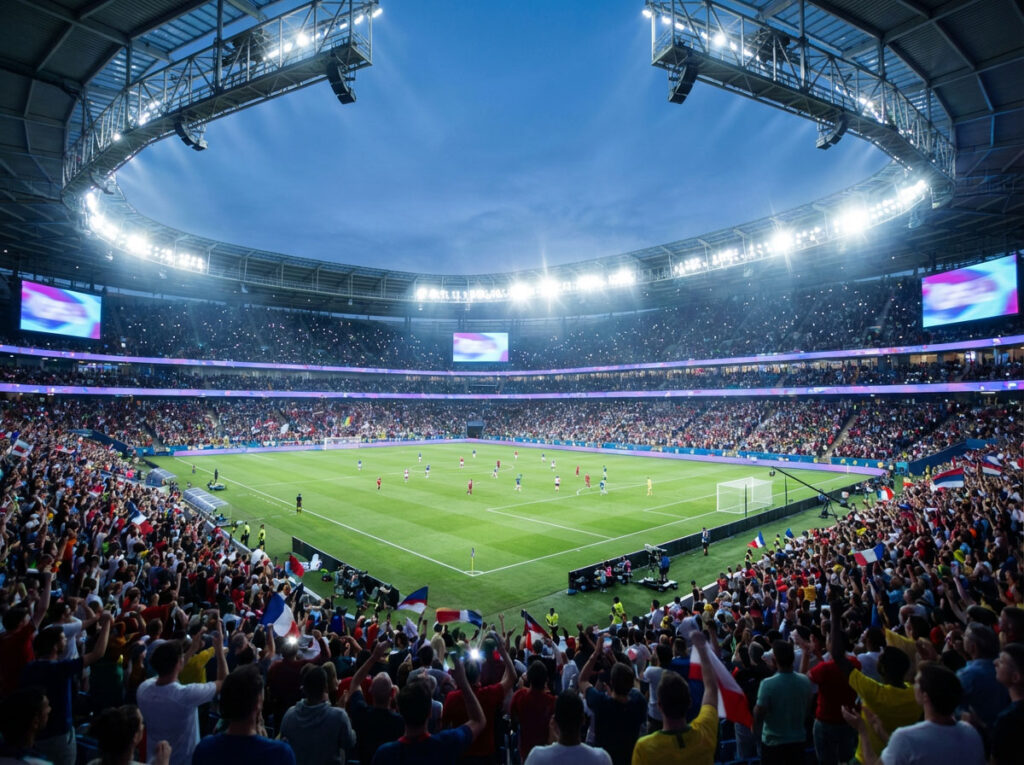
Planning is already well underway for FIFA World Cup 2026, and much of the public conversation centres on transport, security and host city logistics.
These are critical considerations. But there is another layer of planning that plays a quiet yet decisive role in how safely and successfully large events operate: temporary event structures.
From viewing platforms and fan zones to access routes, stair towers and media positions, temporary infrastructure shapes how people move, gather and experience an event long before the first ticket is scanned.
Crowd safety starts with structure, not stewarding
Crowd safety is often discussed in terms of stewarding numbers, policing strategies or emergency response plans. In reality, many of the biggest pressure points are created or removed at the design stage.
Temporary structures influence:
- How crowds enter and exit spaces
- Where people naturally gather or pause
- Sightlines and viewing behaviour
- Bottlenecks around food, retail and amenities
A well-designed platform or access route can reduce congestion before it happens. Poorly planned infrastructure can create risks that no amount of on-the-day management can fully solve.
This is why experienced event teams treat temporary structures as part of the safety strategy, not simply as physical assets.
Fan zones have become environments, not add-ons
Modern fan zones are no longer a screen in an open space. They are multi-layered environments that combine live viewing, hospitality, retail, branding and broadcast activity.
That shift brings new challenges:
- Longer dwell times
- Higher sustained crowd density
- Multiple activity zones operating at once
- Greater expectations around accessibility and comfort
Temporary structures sit at the centre of this evolution. Platforms define viewing areas. Modular buildings house food, bars and production. Access and egress routes dictate how comfortably people move through the space.
When these elements are planned together, fan zones feel intuitive and safe. When they are bolted on late, pressure builds quickly.
Broadcast and media infrastructure changes the equation
Major tournaments are now experienced as much through broadcast and social media as they are in person. That places additional demands on event infrastructure.
Camera platforms, commentary positions, presenter stages and creator areas all require:
- Structural stability
- Clear sightlines
- Safe working access
- Integration into crowd environments without disruption
Media infrastructure cannot be treated as an afterthought. It needs to be designed into the site layout from the outset, balancing broadcast needs with public safety and flow.
Temporary structures provide the flexibility to do this properly, adapting to location, audience size and production requirements.
Early structural planning reduces risk later
One of the clearest lessons from large-scale event planning is that early decisions carry the greatest impact.
When temporary structures are considered early:
- Loadings and capacities are properly assessed
- Access routes are designed with real crowd behaviour in mind
- Sightlines reduce crowd movement and congestion
- Install and derig schedules are more controlled
This doesn’t just improve safety. It improves efficiency for organisers, clarity for contractors and confidence for stakeholders.
Experience matters when scale increases
As events grow in scale, complexity increases quickly. Temporary structures are no longer simple builds; they are engineered environments operating under real pressure.
Experience matters because:
- Live sites rarely behave exactly as drawings suggest
- Crowds don’t always move as predicted
- Weather, broadcast demands and programming changes add variables
Teams who understand how structures perform in real conditions are better placed to design solutions that hold up when it matters.
Looking ahead
With global tournaments, festivals and large public events continuing to scale, the role of temporary event structures will only become more central.
They are not background infrastructure. They actively shape safety, experience and delivery.
For organisers, agencies and production teams, the question is no longer whether temporary structures are needed, but how early and how intelligently they are integrated into the planning process.
At Event & Media Structures, this is the space we work in every day. Designing, engineering and delivering temporary environments that perform under pressure, support crowd safety and enable memorable live experiences.